

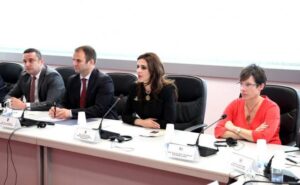

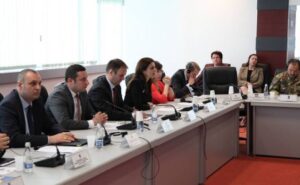




Minister Çitaku appealed on every possible form of mutual cooperation so that the challenges ahead of this community to be overcome together.
Minister Çitaku, at the beginning of this meeting, informed the participants about the commitment of the ministry she leads, but also the commitment of the Government of the Republic of Kosovo, regarding full integration of this community into Kosovar society. “The entire Europe has in the agenda the inclusion of Roma community in society, with equal rights as all other Europeans. In the Republic of Kosovo, there is much done for their inclusion in the society, and not only for this community but others as well, such as Ashkali and Egyptian communities.
We have demonstrated, as a society, that we are close to each other and protect as well respect all residents of the Republic of Kosovo regardless of religion and race. This tells that the Government of the Republic of Kosovo is committed to build a multi-ethnic state. As part of this commitment, in December 2009, the Government adopted the Action Plan that derives from the Strategy of integration of Roma, Ashkali and Egyptian communities for the period 2009-2015. “- added Mrs. Çitaku.
Speaking of the Strategy for Integration of Roma, Ashkali and Egyptian communities, Minister Çitaku stated: “This strategy aims to improve the living conditions of Roma, Ashkali and Egyptians communities, as well as creating political, social, economic, educational and cultural conditions for creating and strengthening the identity, respect and protecting the values of these communities. Through our role as Inter- Institutional Steering Committee for the Implementation of the Strategy on Integration of Roma, Ashkali and Egyptians communities, we are committed to accelerate the implementation of the strategy in order to achieve more concrete results which will directly contribute to positive changes for these communities. This shows that the issue of inclusion of the Roma, Ashkali and Egyptians communities in the society, is part of our political agenda and is taken very seriously by all parties.
This community has many things to be proud of. Roma traditional music among others is definitely the most famous of Roma culture. This community is well-known for a lot of other things. The world recognizes these values, which continue to be transformed, and still remain as favourites to all the other nations around the world – stated Minister Çitaku.
However, the International Roma Day, April 8, marks the first International Congress of Roma in 1971 and the first efforts of the Roma community to unite in order to solve the problems faced by this community throughout Europe.